The Importance of Johannes Brahms: His Influence within and beyond the Nineteenth Century
“Johannes Brahms is a modern of the moderns, and his C-Minor Symphony is a remarkable expression of the inner life of this anxious, introverted, over-earnest age. . . . We venture to express a doubt that this work demonstrates its author’s right to a place beside or near Beethoven.”
Boston Daily Advertiser, January 18, 1878.1
The reputation of Brahms and his music has fluctuated since the mid-nineteenth century when one of the first critical comments, hailing Brahms as “a musician who would reveal his mastery not in gradual stages but like Minerva would spring fully armed from Kronos’s head” and “a young man over whose cradle Graces and Heroes have stood watch,” was published by Robert Schumann—Brahms’s early mentor—in the Neue Zeitschrift für Musik in 1853.[2] On the one hand, although many of Brahms’s contemporaries from the Schumann circle lavished their praise on the composer’s works,[3] Brahms was traditionally portrayed as “conservative” in contrast to the more avant-garde “New German School.”[4] While Hans von Bülow compared Brahms’s talent to Beethoven’s achievement and regarded his first symphony as “[Beethoven’s] Tenth,”[5] others doubted Brahms’s contribution to the symphonic repertoire and questioned his status as an important composer comparable to Beethoven.[6] On the other hand, musicians and scholars who support Brahms’s music have attempted to demonstrate his progressive qualities, notably Arnold Schoenberg, Peter Gay, and Michael Musgrave.[7] It is difficult to conclude whether Brahms was THE most important composer of the nineteenth century; however, in this paper I will trace Brahms’s contribution to the evolution of editing and musicology and the establishment of “museum culture” in music, rendering him indispensable and profoundly influential among later composers and musicologists.
The Evolution of Editing and Musicology
Brahms is among the first scholars to study the historical continuity of music, which was reflected in his immense collections of great value. According to Karl Geiringer, the librarian of the Gesellschaft der Musikfreunde, to which Brahms left his library, Brahms possessed “full sets of the complete editions of Bach, Handel, Schütz, Chopin, Schumann, and Mendelssohn, to which were added a number of magnificent first editions of works of Johann Sebastian and Carl Philipp Emanuel Bach, Domenico Scarlatti and Gluck. . . . [But] unquestionably the most precious part of Brahms’s collection is its autographs [i.e., handwritten manuscripts].”[8] These collections reflect Brahms’s interest in as well as contribution to the research on revered composers of the past; the Bach biographer Philipp Spitta, the Handel scholar Friedrich Chrysander, the Beethoven specialist Gustav Nottebohm, and the music archivists C. F. Pohl (biographer of Haydn) and Eusebius Mandyczewski (editor of Haydn and Schubert) were all friends of Brahms. Brahms not only paid much attention to music of his contemporaries but was also one of the first composers to help publishers edit music of the past. Besides his editing of Schubert’s nine symphonies and Schumann’s works, he was involved in the publication of the first volume of the Bach Gesellschaft edition in 1851 (under Breitkopf & Härtel), which, as Musgrave notes, was “the major musicological event of Brahms’s youth and clearly ranked with Bismarck’s creation of the German Empire in 1871 as a major national event of his life.”[9] As a conductor of the Vienna Singakademie in the 1860s, Brahms, fond of German music as a continuity and supporting the rise of German nationalism in the nineteenth century, rediscovered and programmed choral works of Heinrich Schütz, Henricus Isaac, and J. S. Bach, which were then only beginning to be published. Brahms’s editorial process in Mozart’s Requiem exemplifies how through the manuscript the editor could determine a true indication of how Mozart left the work and how his pupil continued to complete it after Mozart’s death,[10] which set a standard for the editing of critical editions—editions including a thorough study of original sources rather than mere arrangements. Brahms’s collections, as well as his dedication to editing and rediscovering music of the past, helped propel the rise of critical editing and the rise of musicology in nineteenth-century Germany.
The Establishment of “Museum Culture” in Music
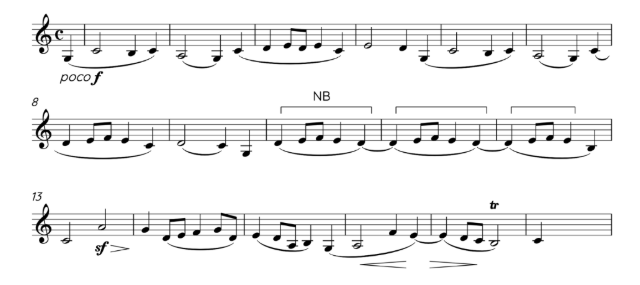
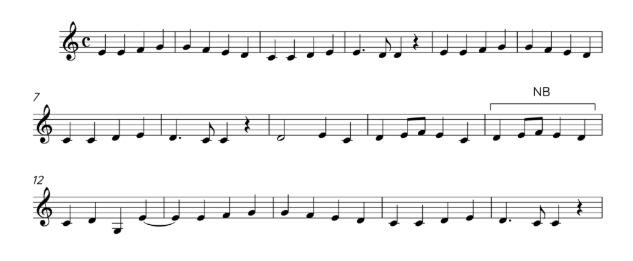
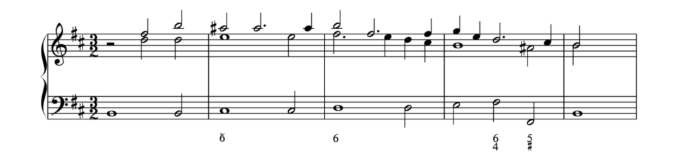
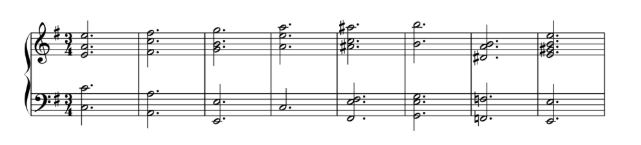
Brahms’s musical antiquarianism benefited not only the evolution of editing and musicology but also his own musical creations. The double-choir format in the three Fest- und Gedenksprüche for Eight-Part Chorus, op. 109, and the Drei Motetten, op. 110, was inspired by the new edition of Heinrich Schütz’s works that began appearing in 1885. In Ein deutsches Requiem, op. 45, Brahms used the same texts that Schütz had set in his Cantiones sacrae of 1625 and Geistliche Chormusik of 1648. Brahms’s reverence for the older German composers and tradition was also revealed in his instrumental pieces. His first symphony in C minor, op. 68, taking him more than twenty years to structure and compose, not only pays homage to Bach and Beethoven in terms of thematic elements (see examples 1 and 2) but also synthesizes those with his own opinion that symphony should return to being purely instrumental by using a melody that closely resembles Beethoven’s Ode to Joy but is lacking the text. As Richard Taruskin points out, Brahms’s attitude toward tradition was “not merely reverential or epigonal, but active, participatory, and anything but uncritical. By not merely attaching himself to the Beethoven tradition but critiquing it, Brahms had brought about (or hoped to bring about) a change of course.”[11] Brahms’s active musical commenting on the tradition appeared again in the Finale of the Fourth Symphony, op. 98, where the entire movement was inspired by the Chaconne movement of Bach’s Cantata 150, “Nach Herr Gott verlanget mich.” Brahms’s critical view of the cantata is witnessed by Siegfried Ochs, accompanied by von Bülow, whom Brahms accused of having little knowledge of Bach’s cantatas. “What would you say to a symphonic movement based on this theme one day? But it is too straightforward, too lumpish. It would have to be chromatically altered in some way.”[12] The result, compared to Bach’s original four-bar theme, turned out to be a phrase expanded to eight measures with a distinctive chromatic A♯ (see examples 3 and 4). Brahms’s ultimate decision to intensify this theme’s scalar ascent through a striking chromatic passing note is another instance of synthesizing materials from the old masters with more modern musical language, rendering Bach’s subject, as Karen Painter points out, “less a theme than a powerful invocation, especially with Brahms’s scoring for trombones, absent in the three earlier movements.”[13] Never was there a period in music history when composers and scholars paid so much attention to works of previous centuries until the late nineteenth century.[14] Brahms was among the first composers and scholars not only to perform but also to critique and “revive” choral music of the Renaissance and Baroque through his own music, not only propelling German nationalism in the nineteenth century but also creating a virtual “museum”—the concert hall—that could include pieces throughout music history that should be remembered and constantly performed, as well as setting a standard for composers of the nineteenth century and beyond on how to write instrumental pieces so that they could stay in the “museum.”
As Burkholder points out, composers began to study, admire, and emulate the composers of the previous several centuries “beginning with the generation of Brahms. . . . In the late-nineteenth-century concert hall, composers of all periods were suddenly contemporaries.”[15] Brahms’s help with the evolution of editing and musicology, together with his contribution to German nationalism and his historical influence as a composer on synthesizing modern techniques with old traditions to create a “museum culture” in concert halls, demonstrates his high importance in music history. And he certainly was one of the most important composers and musicologists because he became part of the tradition of the “museum culture,” which he himself helped to establish.
Ex. 1 Johannes Brahms, Symphony No. 1, IV, main theme
Ex. 2 Ludwig van Beethoven, Symphony No. 9, IV, choral theme (transposed to C major)
Ex. 3 J. S. Bach, Chaconne from Cantata No. 150, “Nach Herr Gott verlanget mich,” mm. 1-4, reduction
Ex. 4 Johannes Brahms, Symphony No. 4, IV (Passacaglia), mm. 1-8, reduction
Citations
1 Quoted from Nicolas Slonimsky, Lexicon of Musical Invective: Critical Assaults on Composers Since Beethoven’s Time, 2nd ed. (Seattle and London, 1965), 68. Quoted also in J. Peter Burkholder, “Brahms and Twentieth-Century Classical Music,” 19th-Century Music 8, no. 1 (Summer 1984): 75–83.
2 Michael Musgrave, A Brahms Reader (Yale University Press, 2000), 66. See also Robert Schumann, “Neue Bahnen,” Neue Zeitschrift für Musik 39, no. 18, ed. Franz Brendel (October 28, 1853): 185-86. The English translation is by Michael Musgrave.
3 For example, Adolf Schubring in the spring of 1862 wrote an extensive commentary and analysis, conceived as an elaboration of Schumann’s “Neue Bahnen” of 1853, on Brahms’s early piano works, with tiny criticism but huge compliment. See Adolf Schubring, “Five Early Works by Brahms (1862),” in Brahms and His World, ed. Walter Frisch and Kevin C. Karnes (Princeton University Press, 2009), 195–215.
4 Franz Brendel crucially supported program music—the Lisztian symphonic poem and Wagnerian music drama—around the 1850s and 1860s. He also coined the term “Neudeutsche Schule” in his address to the first Tonkünstler-Versammlung of 1859. See Thomas S. Grey, “Brendel, (Karl) Franz,” Grove Music Online, Oxford Music Online, accessed November 23, 2025, ed. Deane L. Root, http://www.oxfordmusiconline.com.
6 As shown in the quotation from the Boston Daily Advertiser on January 18, 1878, fifteen days after the Boston premiere of the symphony. See Boston Symphony Orchestra, “Symphony No. 1 in C Minor, Op. 68,” accessed November 23, 2025, https://www.bso.org/works/symphony-no-1-in-c-minor.
7 See Arnold Schoenberg, “Brahms the Progressive,” in Style and Idea: Selected Writings of Arnold Schoenberg, ed. Leonard Stein (New York, 1975), 398-441. See also Peter Gay, “Aimez-vous Brahms?: On Polarities in Modernism,” in Freud, Jews, and Other Germans (New York, 1978), 231-56, as well as Michael Musgrave, “Brahms the Progressive: Another View,” The Musical Times 124, no. 1683 (1983): 291-94, https://doi.org/10.2307/962911.
10 For details of how Brahms edited Mozart’s Requiem, see Musgrave, A Brahms Reader, 164.
12 Quoted in Musgrave, A Brahms Reader, 169, as well as Karen Painter, “Symphony No. 4 in E Minor, Op. 98,” in The Compleat Brahms, ed. Leon Botstein (W. W. Norton, 1999), 73.
14 Although composers of the Renaissance were emulating their predecessors by writing imitation masses—for instance, the Missa super Ave Maria by Antoine de Févin was a tribute to Josquin des Prez’s famous motet Ave Maria—composers were generally paying reverence to contemporaries within a hundred years. After all, music history at that time, unlike art history, had no “Classical era” to “revive,” and composers were unaware of ancient music from the past, as much of it did not survive. For an insightful discussion and detailed reasoning of why this was so, see Richard Taruskin, “‘A Pleasant Place’: Music of the Trecento: Italian Music of the Fourteenth Century,” in The Oxford History of Western Music: Volume 1: Music from the Earliest Notations to the Sixteenth Century (New York, 2009), online ed., Oxford Academic, August 16, 2010, accessed November 23, 2025, https://0-doi-org.library.juilliard.edu/10.1093/actrade/9780195384819.003.010.
Additional Works Consulted
Bozarth, George S., and Walter Frisch. "Brahms, Johannes." Grove Music Online, Oxford Music Online. Accessed November 23, 2025. Edited by Deane L. Root. https://www.oxfordmusiconline.com.
Burkholder, J. Peter. “Brahms and Twentieth-Century Classical Music.” 19th-Century Music 8, no. 1 (Summer 1984): 75-83.
Burkholder, J. Peter. “Museum Pieces: The Historicist Mainstream in Music of the Last Hundred Years.” The Journal of Musicology 2, no. 2 (Spring 1983): 115–34.
Clive, Peter. Brahms and His World: A Biographical Dictionary. Scarecrow Press, 2006.
Grey, Thomas S. "Brendel, (Karl) Franz." Grove Music Online, Oxford Music Online. Accessed November 23, 2025. Edited by Deane L. Root. http://www.oxfordmusiconline.com.
Taruskin, Richard. “The Return of the Symphony: Brahms.” In The Oxford History of Western Music: Volume 3: Music in the Nineteenth Century. New York, 2009. Online edition, Oxford Academic, August 16, 2010. Accessed November 22, 2025. https://0-doi-org.library.juilliard.edu/10.1093/actrade/9780195384833.003.013.


Copyright © 2026 Jiahao Han